Forced to flee Kazakhstan in 2014, Nataliia Sadykova built an independent journalism platform with her husband, Aydos Sadykov, exposing corruption and abuses of power in their homeland. On June 18, 2024, Aydos was shot in the head in Kyiv while Nataliia sat beside him. He died thirteen days later. Today, she continues their investigations from Ukraine, confronting intimidation, digital attacks and legal pressure while demanding justice for his murder.
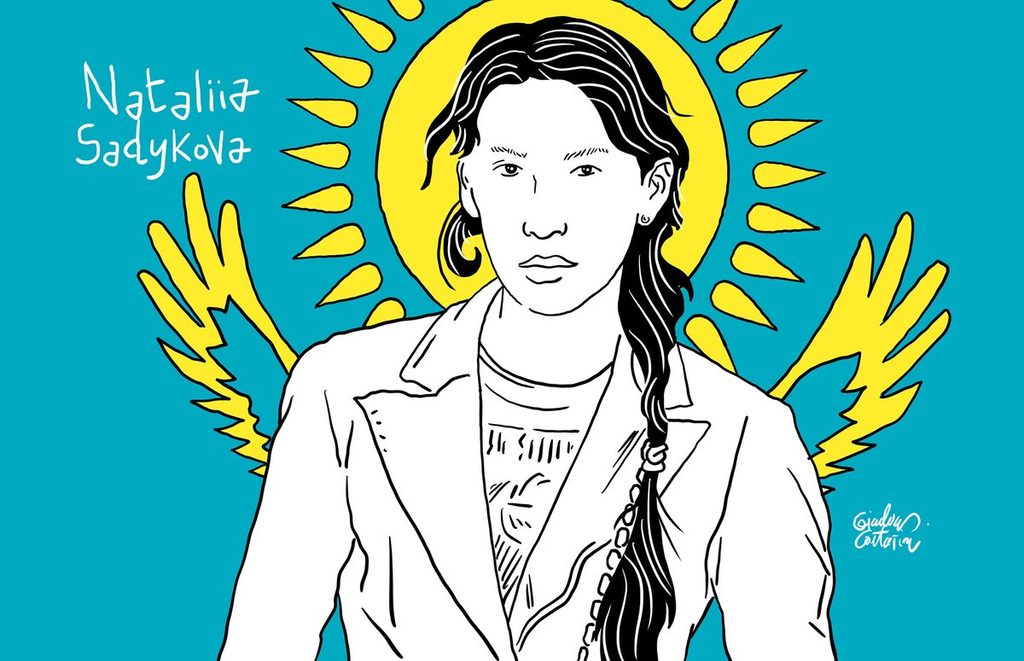
On June 18, 2024, Nataliia Sadykova was sitting beside her husband in their car in Kyiv, the Ukrainian capital where they had lived in exile for a decade. They were approaching their apartment building in the Shevchenkivskyi district when a man appeared near the vehicle, carrying a gun fitted with a silencer. Within moments, he fired at Aydos Sadykov, striking him in the head. Nataliia witnessed the attack from the passenger seat. The couple had spent years investigating corruption and political repression in Kazakhstan, their homeland, believing that distance would allow them to continue working beyond the reach of the authorities they criticized. Instead, the violence they had sought to escape had reached them in the country where they had found refuge. Aydos survived the initial shooting but remained in intensive care for thirteen days before dying on July 2, 2024. His murder transformed Nataliia’s life, but it did not end her commitment to journalism.
Born in 1986 in the Aktobe region of western Kazakhstan, Nataliia had wanted to become a journalist since childhood. In a portrait published by Reporters Without Borders on November 7, 2026, she recalled growing up with a strong awareness of injustice and the conviction that journalism could contribute to changing the world. Her path into the profession was not straightforward. Her mother opposed the idea, and when Nataliia entered university, the journalism course had closed because too few students had enrolled. She studied philology instead, while seeking out journalists, reading newspapers and learning everything she could about reporting. Her professional ambition survived the obstacles of her education, and she eventually entered the media industry while still very young.
During the 2000s, Nataliia worked for private media outlets in Kazakhstan, gaining experience in a country where independent journalism operated under significant political constraints. She gradually discovered that certain subjects could not be investigated freely, particularly when they concerned powerful officials or the interests of the political establishment. The experience shaped her understanding of journalism as something more demanding than the publication of information: it required challenging the boundaries imposed by those who controlled access to public debate. In 2010, she joined Respublika, one of Kazakhstan’s most prominent independent newspapers, which had repeatedly faced pressure from the authorities. For Nataliia, the newspaper represented a model of journalism willing to confront the country’s political and economic elite.
Kazakhstan had been governed since independence in 1991 by President Nursultan Nazarbayev, whose administration consolidated political power while maintaining tight restrictions on opposition movements and independent media. The country’s enormous reserves of oil, gas and minerals generated considerable wealth, but the distribution of economic resources and the relationship between political authority and private business remained central subjects of public controversy. Investigating corruption in this environment meant questioning not only individual decisions but also the structures through which power and wealth were concentrated. Journalists who challenged those structures could face criminal investigations, financial pressure, surveillance and the closure of their publications. For Nataliia, the restrictions became personal in 2014, when Kazakh authorities opened a criminal case against her over an article published by Respublika.
The article concerned public tenders and mentioned a member of Kazakhstan’s parliament. Although another journalist was credited as its author, Nataliia was accused of having written it under a pseudonym. She denied responsibility for the article, but the proceedings exposed her to the possibility of imprisonment. In March 2014, she and her husband decided to leave Kazakhstan with their children. They travelled to Ukraine, which was experiencing the profound political upheaval that followed the Maidan protests and the removal of President Viktor Yanukovych. The family eventually received refugee status and settled in Kyiv. What had begun as an attempt to escape prosecution became a new chapter in their professional lives, as the couple continued to investigate Kazakhstan from abroad. Their departure and the circumstances of the case were later reconstructed by Meduza and Human Rights Watch.
More stories from Kazakhstan
 Gulnara Bazhkenova Sentenced to Eight Years: Press Freedom Under Pressure in Kazakhstan
 Freedom for Raigul Sadyrbayeva
 Justice for Askhat Bgeshov
 Freedom for Aliya Isenova
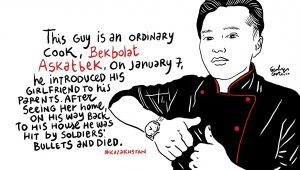 Bekbolat Askatbek
The experience of Nataliia and Aydos belongs to a wider history of journalists and artists forced to leave their countries because of their work. ChannelDraw has documented similar forms of repression, including the experience of Turkish journalists and artists confronting political censorship and persecution. Although the political circumstances differ, these stories reveal how exile can become the price of continuing to investigate power, and how leaving one’s homeland does not necessarily bring an end to the threats that made departure unavoidable.
Aydos Sadykov had his own history of political activism and confrontation with the Kazakh authorities. Born in 1968, he had been involved in opposition politics and campaigns defending workers’ rights, particularly in Kazakhstan’s oil and gas sector. He had led a regional branch of an opposition party and participated in efforts to organize workers employed by major energy companies. In 2010, he was sentenced to imprisonment on hooliganism charges that he and his supporters considered politically motivated. He was released in 2012. His experience of political persecution, combined with Nataliia’s work as an investigative journalist, helped shape a partnership in which journalism and civic activism were closely connected. They shared a belief that documenting abuses of power was essential to challenging them, even when the consequences included prosecution, imprisonment or exile.
In 2016, two years after arriving in Ukraine, Nataliia and Aydos founded BASE, an independent YouTube channel dedicated to investigating political developments, corruption and abuses of power in Kazakhstan. The platform became an alternative source of information for audiences seeking reporting outside the country’s official media structures. Publishing in Kazakh and Russian, they examined the activities of government officials, political leaders and business figures, while also documenting protests and social grievances. Their work attracted a substantial following, eventually reaching more than one million subscribers. For a couple who had been forced to leave their country, the internet offered a way to remain connected to the society they continued to investigate.
The success of BASE was built on a relationship with viewers who increasingly became sources of information. People from different parts of Kazakhstan contacted the journalists with documents, testimonies and allegations that they believed deserved public attention. Nataliia later recalled the intensity of those early years, when the volume of information arriving from Kazakhstan transformed the channel into a demanding, continuous undertaking. The couple worked long hours researching, writing, recording and editing their investigations. Their exile had not separated them from their country; in some respects, it had created a new relationship with it, allowing them to build a digital newsroom that crossed national borders and challenged the traditional mechanisms through which information could be controlled.
But the growth of BASE also increased the risks they faced. The couple reported threats, surveillance and harassment, including attempts to intimidate them through online platforms. In October 2023, Kazakhstan placed both journalists on a wanted list, accusing them of inciting hatred under legislation that human rights organizations have criticized for its vague language and potential use against peaceful expression. Human Rights Watch noted that the provision had frequently been used against activists and journalists, while the Sadykovs rejected the allegations as politically motivated. The criminal proceedings demonstrated that their physical absence from Kazakhstan did not end the authorities’ ability to exert pressure on them.
The situation became even more dangerous after Russia launched its full-scale invasion of Ukraine in February 2022. Nataliia and Aydos remained in Kyiv, living in a country under attack while continuing to investigate political developments in Kazakhstan. Their reporting also criticized Russia’s aggression and examined the relationship between the Kazakh government and Moscow. President Kassym-Jomart Tokayev, who succeeded Nazarbayev in 2019, became a frequent subject of their criticism. The couple accused his administration of maintaining authoritarian practices and questioned its political relationship with the Kremlin. These were political positions expressed by the journalists, not findings that established criminal responsibility by the Kazakh leadership.
On the morning of June 18, 2024, shortly before the assassination attempt, the couple published new material on BASE criticizing Tokayev’s policies and his relationship with Russia. Later that day, Aydos was shot near their home. Nataliia immediately connected the attack to their professional activities. Speaking to journalists after the shooting, she insisted that the violence could not be separated from the investigations they had been publishing. Her words, reported by Radio Free Europe/Radio Liberty, were unequivocal:
“I want everyone to understand one thing. The attack is directly related to our journalistic activities.”
The statement expressed Nataliia’s conviction about the motive for the attack, although determining who ordered the murder and why remains a matter for judicial investigation.
Ukrainian investigators identified two Kazakh nationals as suspects in the shooting. Both were reported to have left Ukraine on the day of the attack. One of them, Altai Zhakanbayev, subsequently surrendered to authorities in Kazakhstan, while the other, Meiram Karatayev, was identified as a suspect in the investigation. Ukrainian prosecutors sought their extradition, but Kazakhstan refused to extradite its citizens, citing its national legislation. President Tokayev publicly stated that Kazakhstan was prepared to cooperate with the investigation, while denying accusations implicating his administration in the killing. The identities of the individuals who may have ordered or financed the attack have not been judicially established. The case has consequently become a major test of international cooperation in investigating violence against journalists living in exile.


CHANNELDRAW STUDIO · INDEPENDENT PUBLISHING
Active Art Yearbook
A year of drawings, stories and civic engagement. Discover the Channeldraw annual volumes.
Explore the yearbooks →The assassination also revealed the vulnerability of political refugees who continue to challenge the governments of their countries of origin. Nataliia and Aydos had left Kazakhstan to escape prosecution, yet their professional activities remained directed towards the same political and economic structures they had investigated before leaving. Their experience illustrates the phenomenon known as transnational repression, in which threats, surveillance, intimidation or violence can extend beyond national borders and target dissidents, activists and journalists living abroad. The killing of Aydos Sadykov demonstrated that exile does not necessarily provide safety when critics remain exposed to actors capable of pursuing them outside their own country. The International Federation of Journalists condemned the murder and demanded a transparent investigation.
The murder of Aydos also belongs to a wider history of violence against journalists whose work challenges powerful interests. ChannelDraw has documented the killing of Evelio López Sánchez, an Indigenous journalist murdered in Guatemala after reporting death threats. The circumstances and investigations are different, but both cases demonstrate the importance of examining threats made before an assassination and of establishing whether the authorities had opportunities to intervene before violence became irreversible.
Stories across the world

On July 2, 2024, Nataliia announced that her husband had died after thirteen days in intensive care. In the statement reported by Ukrinform, she described him as her beloved husband, the father of their three children and a man who had devoted his life to Kazakhstan. She accused President Tokayev of bearing responsibility for his death, an allegation that must be distinguished from the findings of the criminal investigation. Her statement was both an expression of grief and a public accusation, reflecting the conviction that the assassination was inseparable from the political persecution the couple had experienced for years.
The murder left Nataliia responsible for continuing the work they had built together while raising their children in a country at war. She chose not to abandon BASE. Instead, she assumed responsibility for researching, writing, filming and editing its investigations, continuing to examine corruption and abuses of power in Kazakhstan. Her work became inseparable from the demand for justice for Aydos, but it also retained the broader purpose that had motivated the creation of the channel: documenting the actions of those exercising political and economic power and making information available to people who might otherwise have limited access to independent reporting.
The pressure did not end with her husband’s death. According to Reporters Without Borders, Nataliia, her lawyer and journalists reporting on the assassination were subjected to anonymous calls, threatening messages and attempts to compromise their digital accounts. RSF documented phishing operations involving fraudulent messages designed to imitate communications from Google, as well as harassment through Telegram and WhatsApp. Some of the messages referred explicitly to Aydos’s murder, while others appeared intended to undermine the security of Nataliia’s online activities. The organization identified successive waves of digital attacks and reported evidence suggesting the involvement of commercial cyber-surveillance services. These findings revealed how intimidation could continue through technological means even after the most extreme form of physical violence had already occurred.
Digital intimidation has become an increasingly important instrument of repression against independent journalism. ChannelDraw has also examined the case of Saudi journalist Turki al-Jasser, executed in 2025 after years of imprisonment, whose story raised serious questions about online surveillance, the identification of anonymous critics and the dangers of reporting on corruption. Although the circumstances are different, both cases reveal how digital technologies can be used not only to distribute information but also to identify, intimidate and potentially endanger those who challenge political authority.
The harassment also affected the wider environment surrounding Nataliia’s work. Attacks on digital accounts, attempts to impersonate trusted services and threatening communications can disrupt the daily operations of an independent newsroom, particularly one built around a small team and dependent on online platforms. They can expose confidential sources, undermine the credibility of published material and force journalists to devote considerable time and resources to security rather than reporting. In Nataliia’s case, the attacks were especially serious because they followed the assassination of her husband, making every new threat a reminder of the possibility that intimidation could again become physical violence.
In May 2026, Reporters Without Borders announced that it was referring the case to United Nations human rights mechanisms, with Nataliia’s agreement. The organization argued that the investigation into Aydos’s murder had stalled because of insufficient cooperation from the Kazakh authorities, despite the identification of suspects by Ukrainian investigators. The referral sought to increase international pressure for information, judicial cooperation and accountability. Nearly two years after the assassination, the absence of a conclusive investigation had become a central concern for organizations defending press freedom, which warned that impunity could encourage further attacks against journalists operating beyond their countries’ borders.
The legal pressure on Nataliia also continued. In April 2026, a Russian-Kazakh businessman, Gadzhi Gadzhiev, filed a lawsuit against her in Ukraine, alleging that material published on BASE had damaged his reputation. RSF reported that the businessman had previously sought the removal of a video concerning him and expressed concern about the possible use of legal proceedings to intimidate the journalist. The lawsuit raised questions about the use of strategic litigation against public participation, commonly known as SLAPPs, in which legal claims can impose financial and psychological pressure on journalists even before a court reaches a decision. The existence of the lawsuit does not establish that the allegations against Nataliia are valid, nor does it prove that the claimant was involved in the murder. It does, however, form part of the broader pattern of legal and personal pressure documented by press freedom organizations.
On October 1, 2026, the human rights organization Freedom for Eurasia published a report titled Two Years Without Justice: Transnational Repressions by Kazakhstan, examining the assassination of Aydos Sadykov and the continuing intimidation of Nataliia. Drawing on court documents, investigative reporting and its own research, the organization described alleged attempts at bribery and coercion before the murder, campaigns of disinformation targeting the family, digital attacks and surveillance after Aydos’s death. It also raised concerns about alleged connections between individuals involved in surveillance and Kazakhstan’s intelligence structures. These claims require careful distinction between documented events, investigative findings and allegations that have not been established by a court, but the report presents the case as an example of how different forms of pressure can operate together against journalists working in exile.
Freedom for Eurasia called for a stronger response from international institutions, including the European Union, the Organization for Security and Co-operation in Europe and United Nations human rights bodies. Its recommendations included measures to protect journalists in exile from abusive litigation, greater diplomatic pressure for cooperation in the murder investigation and explicit international recognition of the case. The report emphasized that the assassination should not be treated as an isolated event detached from the years of threats and persecution that preceded it. Understanding what happened to Aydos requires examining the entire history of the couple’s journalism, the pressure directed against them and the difficulties encountered by Nataliia in seeking justice.
The broader situation of press freedom in Kazakhstan provides an essential context for understanding these events. Despite changes in political leadership, independent journalists and opposition figures continue to face restrictions, criminal investigations and other forms of pressure. In the 2026 World Press Freedom Index, Kazakhstan ranked 149th out of 180 countries, reflecting serious concerns about the conditions under which journalists operate. The country’s political system has been marked by a concentration of executive power, limited opportunities for independent opposition and persistent questions about the relationship between public institutions and influential economic interests. In this environment, investigative journalism can become one of the few available means of challenging official narratives and exposing allegations of wrongdoing.
For Nataliia, however, journalism is not simply an instrument of political opposition. It is the profession she chose as a young woman and the work through which she has tried to understand and document the society in which she was born. The distinction matters because her life cannot be reduced to the assassination of her husband or to the threats she has received. She was already an experienced journalist before the family fled Kazakhstan, had worked for independent publications, and helped create a platform that reached a large audience across national borders. Her professional identity preceded the tragedy, and her decision to continue reporting after it demonstrates that the work she and Aydos shared was rooted in a commitment extending beyond their personal circumstances.
The November 2026 portrait published by Reporters Without Borders offers an unusually personal account of that commitment. Nataliia speaks about her childhood ambitions, the obstacles she encountered in becoming a journalist and the intensity of building BASE with her husband. She also describes the difficulties of continuing alone while raising her children in wartime Ukraine. Asked about the threats that still surround her, she offers a sentence that captures the distance between the young woman who dreamed of journalism and the person who has endured exile, persecution and the murder of her partner:
“After all that has happened to me, there isn’t much that scares me.”
The words are not an expression of indifference to danger. They reflect the experience of someone who has already witnessed the consequences of political violence at their most devastating and nevertheless refuses to abandon her profession.
Nataliia now holds Ukrainian citizenship, but her relationship with Kazakhstan remains central to her identity and work. The possibility of returning to her country of birth is complicated not only by the political circumstances that forced her into exile but also by the life she built in Ukraine and the death of her husband there. In the RSF interview, when asked whether she might return to Kazakhstan if political conditions changed, she hesitated. Aydos is buried in Ukraine, and the country that once offered the family refuge has become the place where she must confront both her personal loss and the continuing war. Exile, in her story, is no longer simply a temporary geographical separation from her homeland. It has become a condition in which memory, family, professional responsibility and political identity are divided between two countries.
The assassination of Aydos Sadykov remains unresolved, and the question of who ordered the killing continues to demand answers. Ukrainian investigators have identified suspects, but judicial cooperation between Ukraine and Kazakhstan has not produced the accountability sought by Nataliia and international press freedom organizations. The allegations concerning possible involvement by individuals connected to Kazakhstan’s security structures remain subjects of investigation and public controversy rather than established judicial conclusions. Preserving these distinctions is essential, because the demand for justice depends on evidence, transparent procedures and the identification of responsibility through credible investigations.
For ChannelDraw, which documents the lives of journalists, dissidents and human rights defenders through political illustration and visual journalism, Nataliia Sadykova’s story embodies the human consequences of the struggle for freedom of information. Her experience connects several forms of repression that are too often examined separately: criminal prosecution, forced exile, online harassment, threats against family members, physical violence and legal pressure. It also reveals the resilience of independent journalism when its survival depends not on large institutions but on the determination of individuals who continue working despite the personal risks.

This commitment to preserving the identities and stories of persecuted journalists is also reflected in ChannelDraw’s collaboration with Wahrheitskämpfer, an international visual archive dedicated to reporters who have been killed, imprisoned or forced into exile. Through drawing, their individual experiences become part of a collective memory of the struggle for freedom of information. Portraiture becomes more than an act of remembrance: it restores visibility to people whose persecutors would prefer to reduce them to statistics, criminal accusations or silence.
The murder of Aydos was intended, or at the very least had the potential, to destroy the work the couple had built together. Instead, BASE continues to publish, and Nataliia continues to investigate the political and economic structures that shaped their reporting for years. Her persistence does not diminish the tragedy of her husband’s death or remove the dangers she still faces. It makes visible a different dimension of the story: the struggle to prevent violence from determining what can be said, investigated or remembered.
There is also a broader responsibility that extends beyond Kazakhstan and Ukraine. Governments and international institutions must recognize that journalists in exile can remain vulnerable to threats originating from the countries they have left. Protection requires more than granting asylum or condemning an assassination after it occurs. It demands effective cooperation between judicial authorities, safeguards against digital surveillance and harassment, mechanisms to prevent abusive legal proceedings, and sustained attention to the security of journalists and their families. Without these protections, the ability to report across borders may coexist with an equally transnational capacity to intimidate and silence.

The same conviction informs In the Crosshairs of Memory, ChannelDraw’s ongoing project portraying journalists killed while documenting the war in Gaza. Although the circumstances are different, the underlying principle remains the same: a journalist’s death must never become an excuse to forget the questions they were asking or the stories they were trying to tell. Remembering a journalist means preserving the significance of their work, investigating the circumstances of their death and refusing to allow violence to erase the information they sought to make public.
Nataliia Sadykova has spent much of her adult life investigating abuses of power. She lost her homeland to exile and her husband to an assassin’s bullet, yet she continues to work as a journalist, searching for answers about his death while documenting the country they never stopped examining. Her story is not only about grief or survival. It is about the refusal to accept that violence should have the final word over truth.
Aydos Sadykov was killed in Kyiv in 2024. More than two years later, justice has not been achieved. Nataliia continues to publish, investigate and demand accountability. Her work is a reminder that killing a journalist does not necessarily silence the questions that journalist was asking — and that the people who remain may carry those questions forward with even greater determination.
ChannelDraw is independent and reader-supported. Your support helps us continue documenting artists, journalists and activists whose voices are threatened or censored.
Other ways to support ChannelDraw
You can also support our independent work by joining us on Patreon or Substack, or by purchasing a ChannelDraw Yearbook. Every contribution helps us keep ChannelDraw independent and continue documenting stories that need to be seen.


