On October 20, 2026, Libyan journalist Hassan Bakir was kidnapped outside his newsroom in Misrata, taken to Tripoli, beaten and threatened with death over his investigations into corruption and public contracts. After surviving the attack, he spoke publicly about his ordeal and announced his intention to identify those responsible. His story exposes the dangers facing journalists who challenge powerful interests in a country still struggling with political fragmentation, armed violence and impunity
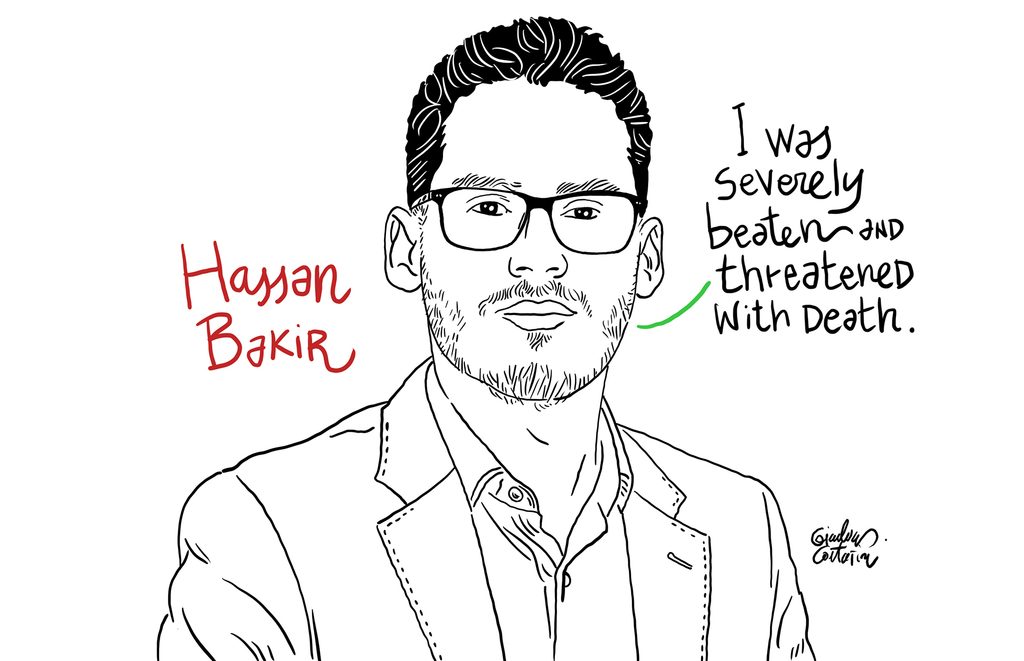
On October 20, 2026, Hassan Bakir, a journalist working for the Libyan News Agency (LANA), was abducted by armed men outside his newsroom in Misrata, a major coastal city in northwestern Libya. According to Reporters Without Borders (RSF), the attackers forced him into a vehicle and transported him to Tripoli, more than 200 kilometres away, where he was held captive, interrogated and subjected to physical violence. The kidnapping was reportedly connected to his investigations into corruption, the alleged misappropriation of public funds and the awarding of government contracts, subjects that place journalists in direct confrontation with political and economic interests in a country where armed groups continue to exercise considerable influence.
The circumstances of the abduction suggest a deliberate attempt to intimidate a journalist whose reporting had become uncomfortable for individuals determined to prevent further scrutiny. According to Bakir’s account, his captors questioned him about his investigations and demanded that he abandon his work on corruption. They threatened to kill him if he continued. Although the identities of the perpetrators and their possible connections to the subjects of his reporting have not been publicly established, the questions reportedly asked during his captivity indicate that his journalistic activities were central to the attack. It was not simply an act of violence against an individual but an assault on the right to investigate how public resources are distributed and who benefits from government decisions.
Footage circulated on social media appeared to show the moment of the kidnapping. As reported by the Libyan newspaper Al Wasat, masked men intercepted Bakir’s vehicle and forced him into another car. The images intensified concern about his disappearance and offered a disturbing illustration of the vulnerability of journalists working in an environment where armed individuals can operate with apparent confidence, even in public spaces. For reporters investigating sensitive political and financial matters, the possibility of being abducted outside a newsroom reveals the distance between the formal recognition of press freedom and the actual conditions under which journalism is practised.
During his captivity, Bakir was reportedly restrained with plastic ties, repeatedly beaten and subjected to threats. His captors covered his head with a black bag and concealed his eyes during the journey from Misrata to Tripoli. He later described the physical violence he had endured and published photographs and a video on social media that he said documented his injuries. In a statement reported by Al Wasat, he described his treatment in stark terms:
“I was severely beaten and threatened with death.”
The statement, translated from Arabic, captures the brutality of an attack in which violence was used not only to punish a journalist but also to force him into silence. The threats were reportedly linked to his investigations into the allocation of public contracts, making the assault particularly significant in the context of Libya’s continuing difficulties with transparency, institutional accountability and the management of state resources.
During the night between October 20 and 21, Bakir was abandoned along a highway, where he was found by security personnel. He was subsequently taken to the Iwan Specialized Hospital in Misrata for medical treatment. His survival ended the immediate uncertainty surrounding his disappearance, but it did not resolve the questions raised by the attack: who organized the kidnapping, who carried it out, whether others directed or facilitated the violence, and whether the authorities would be able to investigate the case independently and bring those responsible to justice.
Following his release, Bakir publicly described the violence he had suffered, sharing images that he said showed the injuries inflicted by his abductors. According to Al Wasat’s report of October 22, he also announced that he had begun gathering information about the individuals involved in the kidnapping and those who might have supported them. He expressed his intention to hold a press conference once his health had improved, promising to provide further details about what had happened. He also thanked his family, his community and those who had expressed solidarity during his disappearance and recovery. His statements suggested a determination to pursue accountability rather than allow the threats he received to end his public testimony.
This decision is especially significant because the consequences of an attack on a journalist do not necessarily end with release from captivity. Physical injuries may heal, but the threat of renewed violence can continue to affect a reporter’s professional activity, family life and personal security. When abductors explicitly warn a journalist to abandon an investigation, the intimidation is designed to extend beyond the immediate assault, influencing future editorial decisions and discouraging others from examining similar subjects. Bakir’s announcement that he intended to speak publicly about his experience therefore represented an important refusal to allow his captors to determine what could or could not be reported.
The kidnapping provoked reactions from Libyan civil society and human rights organizations. On October 20, while Bakir’s whereabouts were still unknown, the National Council for Public Liberties and Human Rights condemned his abduction and expressed concern about the use of kidnapping and detention outside the law. The organization called for his immediate release, demanded an investigation by the Attorney General’s Office and emphasized that no accusation against an individual could justify an arrest carried out without legal authorization or judicial oversight. The Libyan News Agency, the institution for which Bakir works, also reported demands from human rights organizations for his protection and the clarification of the circumstances surrounding his disappearance.
FROM THE CHANNELDRAW ARCHIVE
More stories on Libya
 08 September 2025
Libya: Book Presentation – Resistenze in Cirenaica Festival
Read story ↗ 15 May 2024
Gianluca Costantini at Comicdom in Athens
Read story ↗ 19 March 2023
Attraversamenti: la migrazione nel fumetto
Read story ↗ 17 March 2023
La Bande Dessinée du réel, une nouvelle forme de journalisme?
Read story ↗ 01 December 2022
Gianluca Costantini: Cartografo potenziale
Read story ↗ 30 November 2022
Une mer de nouvelles bandes dessinées italiennes 2019-22
Read story ↗ 24 November 2022
Libia, dalla realtà della graphic novel al buio in sala
Read story ↗ 16 November 2022
Se anche il fumetto di realtà diventa transmediale.
Read story ↗ 16 October 2022
La tournée di “Libia” di ErosAntEros
Read story ↗ 13 September 2022
“Libia” in teatro
Read story ↗Swipe or use the arrows to browse 10 stories. Explore the Libia archive ↗
After Bakir was found, professional associations and civil society groups welcomed his survival while insisting that his release did not eliminate the need for accountability. As Al Wasat reported on October 21, several organizations called on the authorities to establish the circumstances of the kidnapping and bring the perpetrators before the courts. Their position reflected a fundamental principle: the end of an unlawful detention does not erase the crimes committed during it, nor does it relieve public institutions of their responsibility to prevent similar attacks. Without an effective investigation, the release of a victim can become merely the conclusion of one episode of violence rather than a meaningful step towards justice.
On October 23, Reporters Without Borders publicly condemned the kidnapping, the reported torture and the death threats against Bakir, calling on the Libyan authorities to conduct a thorough and transparent investigation. The organization also demanded measures to protect the journalist and his family, recognizing that the threats made during captivity could continue to affect their safety after his release. RSF presented the case as an illustration of the dangers faced by journalists investigating corruption in Libya and of the impunity that can allow armed actors to intimidate reporters without facing immediate consequences.
To understand why an investigation into public contracts might provoke such extreme violence, it is necessary to consider Libya’s political and institutional history since the overthrow of Muammar Gaddafi in 2011. The collapse of the former regime did not produce a stable transition towards a unified democratic state. Instead, competing political authorities, armed factions and regional power structures emerged, while successive conflicts weakened the institutions responsible for maintaining security and enforcing the law. The country became divided between rival centres of authority, and the competition for control of territory, public institutions and economic resources became one of the defining features of its political landscape.
Libya’s substantial oil wealth makes the management of public money particularly important. State revenues, infrastructure contracts, reconstruction projects and the distribution of economic resources are not simply administrative questions; they are also potential sources of political influence and economic power. In an environment where institutions are fragmented and armed groups retain influence, investigating the allocation of public funds can mean examining relationships between political actors, private interests and organizations capable of exercising coercion. For journalists, such reporting can therefore involve risks that go far beyond the normal professional challenges of obtaining documents, interviewing sources and verifying financial information.
The political fragmentation became particularly pronounced after 2014, when rival institutions and armed coalitions competed for control of the country. Although international mediation and successive political agreements have attempted to establish a unified framework of governance, Libya has continued to experience institutional divisions, particularly between authorities based in Tripoli and competing power centres in the east. Armed groups have remained influential in various parts of the country, sometimes operating alongside or within institutions formally associated with the state. This complicated relationship between public authority and armed power has profound consequences for freedom of expression, because the institutions that should protect journalists may themselves lack the independence or capacity necessary to confront those who threaten them.
The problem extends beyond journalism. Arbitrary detention, abductions and enforced disappearances have repeatedly been documented by international organizations monitoring the human rights situation in Libya. On October 9, 2026, less than two weeks before Bakir’s kidnapping, the United Nations Support Mission in Libya (UNSMIL) expressed concern about reports of disappearances, unlawful detention and abductions involving several individuals in different parts of the country. The mission referred to the cases of Mohamed Sharafeddine Al-Fituri and Abu Bakr Al-Jarrari in Tripoli, as well as Mustafa Al-Sheikh and Mohammed Al-Sheikh in Ghat, calling on the competent authorities to establish their whereabouts, guarantee their safety and ensure that any deprivation of liberty complied with legal procedures.
Although these cases are not known to be connected to Bakir’s kidnapping, they provide important context for understanding the wider pattern of insecurity affecting individuals who may become targets of armed actors. The absence of effective safeguards against arbitrary detention creates an environment in which journalists, activists and ordinary citizens can be exposed to serious violations of their fundamental rights. When those responsible for such acts are not identified or prosecuted, the resulting impunity can reinforce the perception that violence is an effective instrument for resolving political disputes, suppressing criticism or protecting economic interests.
For investigative reporters, the consequences are particularly damaging because intimidation affects not only the individual journalist but also the wider public’s access to information. When someone is threatened for examining public contracts or alleged financial misconduct, other journalists may become reluctant to investigate similar subjects, while sources may fear speaking openly about wrongdoing. The result can be a gradual reduction in the information available to citizens about how their country’s resources are managed. Corruption becomes harder to expose precisely because the people who might reveal it are made to fear the consequences of doing so.
Bakir’s reporting, as described by RSF, concerned the alleged diversion of funds in the awarding of contracts and public projects. These are matters of direct public interest, especially in a country where reconstruction, infrastructure, healthcare and public services depend on the effective and transparent use of state resources. Investigating how contracts are awarded can reveal conflicts of interest, irregular financial arrangements or failures of oversight, but such investigations require access to information and the ability to publish findings without fear of retaliation. The public’s right to know how its money is spent cannot be separated from the journalist’s right to ask difficult questions.
The use of social media to publish investigations is another significant aspect of the case. In countries where traditional media institutions face political pressure, financial instability or restrictions on editorial independence, digital platforms can provide alternative channels through which reporters reach audiences and circulate information. At the same time, the visibility of these platforms can expose journalists to harassment, surveillance and direct threats, particularly when their reporting concerns identifiable individuals or organizations with significant influence. The platforms that make independent reporting possible can also make journalists more visible to those who wish to prevent further scrutiny.
Bakir’s experience illustrates this contradiction. His captors were reportedly familiar with the subjects he had been investigating and sought to force him to abandon them. This apparent connection between his reporting and the threats he received is central to RSF’s condemnation, even though the precise motives and organizational affiliations of the kidnappers remain matters for investigation. The distinction is important: the evidence available publicly supports serious concern that Bakir was targeted because of his journalism, but it does not establish the identity of those who ordered or carried out the attack.


CHANNELDRAW STUDIO · INDEPENDENT PUBLISHING
Active Art Yearbook
A year of drawings, stories and civic engagement. Discover the Channeldraw annual volumes.
Explore the yearbooks →For ChannelDraw, which documents attacks against journalists, human rights defenders and people who challenge abuses of power through visual journalism and political portraiture, Hassan Bakir’s story represents another example of how the struggle for access to information is inseparable from the personal risks faced by those who produce it. Behind debates about transparency, public accountability and freedom of expression are individuals whose professional decisions can expose them and their families to intimidation, imprisonment or physical violence. A journalist investigating public expenditure is not merely examining financial records; he is defending the possibility that citizens can question those who exercise power in their name.
The case also raises questions about the responsibilities of the authorities in Misrata and Tripoli. An effective investigation must establish how the abduction was organized, identify the individuals who participated in it and determine whether other actors directed or facilitated the attack. It must also examine whether Bakir’s previous reporting or any threats he may have received were known to the authorities and whether preventive measures could have reduced the risks he faced. Equally important is the need to ensure that the journalist can continue his work without further intimidation. Protection cannot be limited to the immediate period following an attack, particularly when the perpetrators have threatened to kill their victim if he resumes his investigations.
As of October 24, 2026, the information made public by RSF and Libyan media had not established the identities of those responsible for the kidnapping. Nor had it established whether the attackers acted independently, on behalf of individuals implicated in Bakir’s reporting or as members of a particular armed organization. These questions remain open, and any attempt to attribute responsibility to specific political or military actors without evidence would risk obscuring rather than clarifying the circumstances of the attack. What is documented is that a journalist investigating corruption was abducted in daylight, transported across a substantial distance, subjected to violence and threatened with death if he continued his reporting.
Hassan Bakir survived the kidnapping, but his release does not mark the end of the story. The investigation into what happened to him, the identification of those responsible and the measures taken to protect him will help determine whether this attack becomes another unresolved episode of violence against journalists or an opportunity to establish accountability. In a country where competing institutions and armed groups have repeatedly challenged the rule of law, the ability of a journalist to investigate public money without facing abduction or torture is a fundamental test of freedom of expression. Protecting Hassan Bakir means defending not only his individual rights but also the right of Libyan society to know how public resources are used, who benefits from government decisions and whether those exercising power can be held accountable.
Hassan Bakir is alive. His attackers remain unidentified, and the demand for justice continues. His right to investigate corruption must not depend on the permission of those who may fear what his reporting could reveal.
The violence experienced by Hassan Bakir also recalls the stories documented in Libia, the graphic journalism book written by investigative journalist Francesca Mannocchi and illustrated by Gianluca Costantini, published by Mondadori in October 2019. Through testimonies, reporting and drawings, the book explores the human consequences of Libya’s political fragmentation following the 2011 uprising, moving beyond the simplified narratives of international news coverage to examine the daily lives of people living amid insecurity, economic collapse, arbitrary detention and the influence of armed groups. Rather than presenting Libya exclusively through the perspectives of governments, military leaders or international diplomacy, Mannocchi and Costantini focus on ordinary Libyans: families waiting for missing relatives, young people struggling with the consequences of war, and citizens whose everyday existence is shaped by fear, uncertainty and the erosion of public institutions.
Seven years after its publication, the events surrounding Hassan Bakir’s kidnapping reveal how many of the conditions explored in Libia continue to affect the country. The arbitrary exercise of power, the vulnerability of individuals confronting armed actors and the difficulties of obtaining justice remain central questions, while journalists investigating corruption face particular risks when their reporting challenges influential interests. Bakir’s experience adds another dimension to the reality portrayed in the book, demonstrating how the struggle to document Libya’s present can itself become a dangerous act. Awarded the Premio Coco for Best Book at Etna Comics in 2020, Libia remains an important contribution to graphic journalism and an attempt to understand the country through the experiences of those who live there, rather than through the political narratives imposed upon them from outside.
ChannelDraw is independent and reader-supported. Your support helps us continue documenting artists, journalists and activists whose voices are threatened or censored.
Other ways to support ChannelDraw
You can also support our independent work by joining us on Patreon or Substack, or by purchasing a ChannelDraw Yearbook. Every contribution helps us keep ChannelDraw independent and continue documenting stories that need to be seen.


